
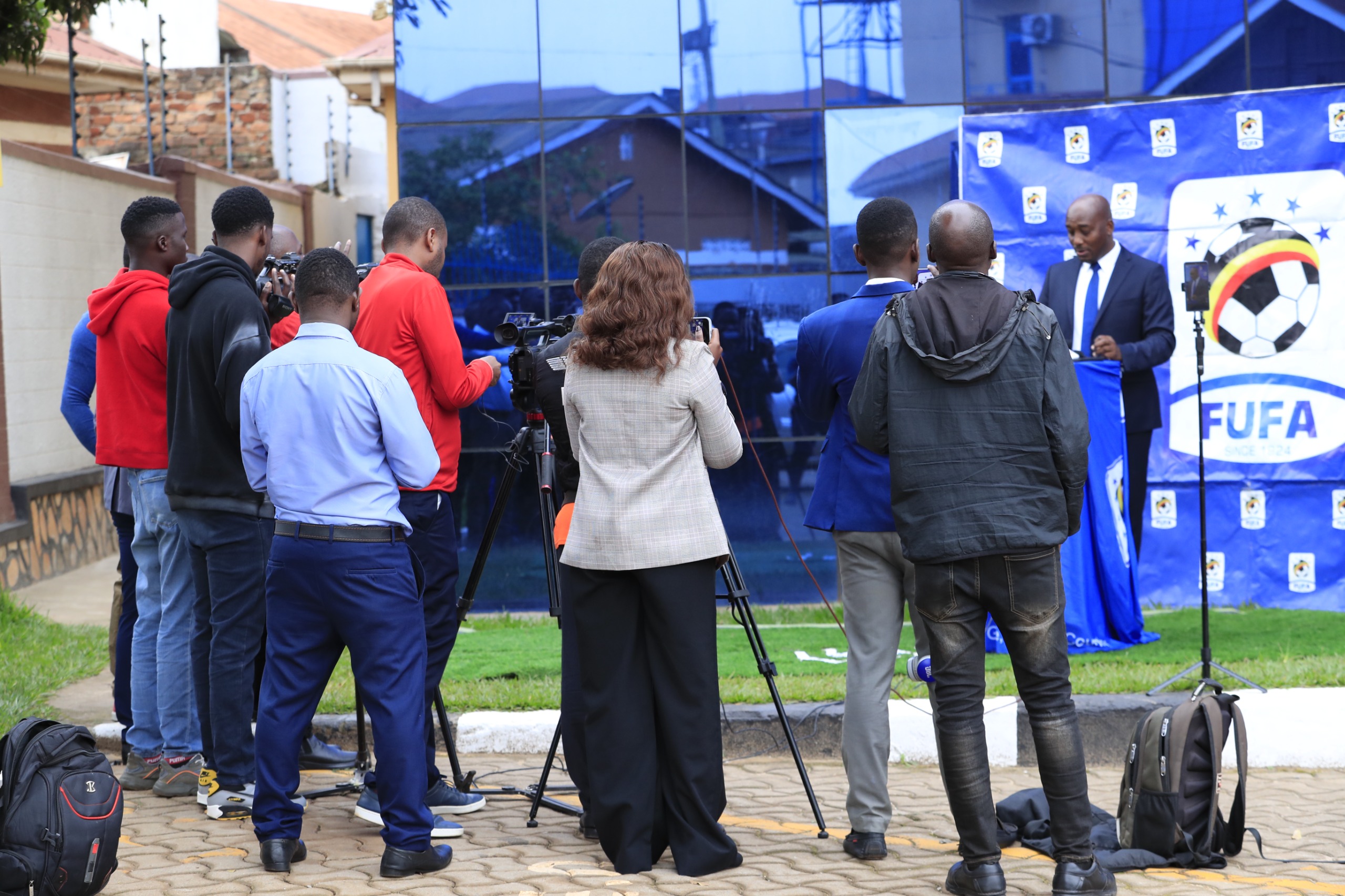
LEAD PHOTO: Mr. Ahmed Marsha Hussein, Director Communications at FUFA, today, responding to media about FUFA’s petition to Parliament
BY MOSES MUGALULA
ON 7th August, 2025 during a stakeholders meeting held at State House Nakasero, President Museveni angrily reacting to the poor performance of the Uganda National Football Team in the CHAN 2024 opening match against Algeria, where the host Uganda Cranes lost to The Desert Foxes 3, nil at The Mandera National Stadium.
Mr. Museveni affirmed that the Government of Uganda is ready to finance talent identification, development and domestic football competitions in Uganda to improve the performance of the National Teams.

Together with The First Lady, Mr. Museveni directed the Football governing body, FUFA headed by Hon. Eng. Moses Magogo to dream bigger and see how to build and develope the game.
By presenteing a ‘wishlist’ to the Committee of Education and Sports at The Parliament of Uganda, on January 27, 2026, The Federation of Uganda Footballl Association (FUFA) was simply puting into consideration, a directive from The Head of State.
This petition targets to develop football in the country and make the sport more loved, a source of employment and revenue.
However, a section of people whose motives are not known, chose to mislead the public by creating a bad impression about FUFA’s well guided move! As if they are not aware that The Head of State and The 1st Lady mama Janet Museveni who doubles as the Education and Sports Minister, already endorsed and blessed the move.
It is absurd to realise that the usual media houses and some persons have been hoodwinked to distort facts for their own benefits.
The public needs not to listen to the noise makers!
IMPORTANT TO NOTE
1) Aware of the resolution of the Parliament of Uganda on 10th September 2025 out of the motion by the minister of state for education and sports, Hon. Peter Ogwang paying tribute to the outstanding performance of the Uganda National Senior Football Team in the 2024 CHAN Edition that club football in Uganda gets funded from the consolidated Fund and the Budget Frame Work Paper from the respective vote includes this priority for the 2026/7 Financial Year.
2) Cognizant that Kenya, Tanzania and Uganda will be hosting AFCON 2027 and that the performance of the Uganda National Football Team will be key to the success of the event.
BUDGETING PROCEDURE
1) The Appropriation Act (National Budget) is a law that originates from a bill, as with all laws. The lawmaking process involves several stages, and in this case, the National Budget Framework Paper (NBFP) is a mandatory stage that serves as the country’s wish list. Its purpose is to list proposed policies, the underfunded and unfunded priorities for consideration by the Ministry of Finance, Planning and Economic Development (MOFPED) and the responsible entities.
2) After Parliament, the NBFP report is returned to the relevant government entities (like ministries, departments, and agencies—MDAs) so they can scrutinize it. This allows them to see if an opportunity arises to fund some of these underfunded/unfunded priorities when they later submit their detailed Ministerial Policy Statements and the actual budget estimates.
3) The Parliament of Uganda (PoU) operates under its Rules of Procedure (RoP). Specifically, RoP #148(1), 31(7), 216(1), and 218(a) permit private individuals, companies, associations, and others to engage with the PoU on matters under discussion that concern their interests.
In this regard, FUFA, a private association, complied with these rules by submitting a document to the committee.
FACTS
1) On 27th January 2026, NCS (Vote 166) presented its Budget Framework Paper (BFP) report to the Education and Sports committee without input from FUFA, a key technical stakeholder and the principal beneficiary of the subvention on the vote.
2) The copy of the report presented by NCS was only made available to the committee at the start of the presentation. So not only FUFA but also the committee did not get to see what was in the NCS Report until it was being presented.
3) A brief review of the report uncovered several key omissions and indicated that some of the information supplied about football was not technically tailored for football.
4) FUFA is a private organisation of an associative nature comprised of 34 members as listed in Article 10 of its Statutes. It is not an MDA.
5) In consideration of C(3) and D (4), FUFA’s petition was in accordance with the law and a procedural move to correct these “errors of omission and commission” and to ensure that its policy proposals and priorities were included in the NBFP for consideration.
6) Context of FUFA’s Petition: The core issue was that the National Council of Sports (NCS), when presenting its NBFP report to parliament, did not accurately or fully capture football’s unfunded priorities, contrary to the meetings referenced in B (1) and the parliamentary resolution referenced in B (2) of this document.E
CONTENT OF THE FUFA DOCUMENT
▪︎ The FUFA Presentation quoted the relevant provisions in the documents listed in A (1), which is a mandatory requirement for the NBFP.
▪︎ The document did not include any provisions for organising the AFCON 2027 event, but it did include measures to improve the performance of National Teams and Clubs in continental and world competitions. This had been a concern of HE, the President, and FUFA was tasked with proposing what is required for Uganda to compete and win at the highest level.
▪︎ The comparative advantages of the elite footballing nations in Africa were listed, and FUFA proposed strategic policy and financial undertakings to improve the performance of the National Teams and Clubs in Continental and World Competitions in the short and long term:
a) Short-term strategy: Naturalise more eligible players of Ugandan descent to boost competitiveness for AFCON 2027.
b) Long-term strategy: Implement a hybrid model combining nation-wide talent identification, top-notch elite development and early export (as in Senegal and Ghana) and strengthening domestic leagues (as in Egypt, S. Africa and Tanzania).
▪︎ Key pillars of the proposal include:
a) Policy & Regulation: Adjust policies to incentivise private investment, enforce school sports facilities, and direct state-owned enterprises (SoEs), ministries, departments and agents of Government (MDAs) to finance community clubs but not run their own football clubs.
b) Infrastructure: Build and upgrade stadiums across all administrative levels, from international venues to village pitches.
C) Funding & Implementation: Finance FUFA’s Technical Master Plan, covering mass football, elite development, professional clubs, and post-career pathways. This includes;
(i) Providing balls to 45,000 Primary Schools and 72,000 Villages in Uganda.
(ii) Providing balls and training equipment to 146 Academies (Grade-4), 18 Schools of Excellence (Grade-3), 8 Academies (Grade-3), 34 Academies (Grade-2).
(iii) Support for Youth Competitions
(iv) Operate a National Football Academy (Grade-1)
(v) Support for club football, including prize money, insurance, continental support, competition organisation, referees, kits, capacity building, FUFA Big League, FUFA Women Super League, and reserve leagues.
d) Media & Production: to improve the quality of production, transmission and broadcast of a dedicated football TV channel to increase visibility, analytics, commercial value and the use of Video Assistant Referee (VAR)
e) Financing Models: Combine government budget allocations, support from state-owned enterprises, and private-sector partnerships.
▪︎ Expected outcomes
(i) Enhanced national team performance and domestic league quality.
(ii) Formalisation of Football as an employment sector, contributing to GDP and tax revenue.
(iii) Growth in sports tourism, foreign exchange earnings, and national pride.
(iv) Youth engagement and reduction in crime through structured sporting pathways.
WAY FORWARD
a) The Minister of State for Sports directed that FUFA and NCS harmonise the documents and submit one holistic document through the government channels.
b) A meeting between NCS and FUFA was held on 28th January 2026, and observations were made.
c) NCS commended FUFA for a well-organised and rich document with content that would have made their submission to the committee better
d) NCS pointed out and asked FUFA to correct clerical errors in the FUFA document and agreed to amend its own document where errors of omission and commission had been observed
e) NCS asked FUFA to formally submit the document for consideration. On 29th January 2026, FUFA submitted the document with modifications as guided by NCS
f) NCS promised to write to the committee of Parliament as an addendum for the FUFA Document to be considered after the line Ministry Approval
g) NCS promised to get back to FUFA on the next actionable issues if any.
For views/comments on this story, Whatsapp editor on 0701523039